
Watch the video without reading the text first. Two friends are sitting together in a park. Try to understand what is happening and what they are saying.
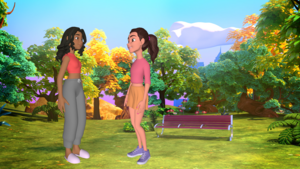
Don't forget to like the video and subscribe to the channel.
Watch the video again while reading the text. Check whether you understand more and pay attention to how the words are pronounced.
A: Wat fijn om even buiten te zijn!
B: Ja, het is echt lekker weer. Niet te warm, niet te koud.
A: Ik kom graag naar dit park. Het is rustig en groen.
B: En er zijn veel vogels! Hoor je dat?
A: Ja, prachtig. Heb je iets te eten meegebracht?
B: Ja, ik heb broodjes en appels. En jij?
A: Ik heb wat koekjes en water.
B: Perfect. Een kleine picknick!
A: Wil je wandelen na het eten?
B: Graag! Misschien rond het meer?
A: Goed idee. Daarna kunnen we even op een bankje zitten.
B: En gewoon genieten van de natuur.
A: Precies. Dit is echt ontspannen.
Read the English translation. Make sure you understand the Dutch conversation.
A: It’s so nice to be outside for a bit!
B: Yes, the weather is really nice. Not too warm, not too cold.
A: I like coming to this park. It’s quiet and green.
B: And there are lots of birds! Can you hear them?
A: Yes, beautiful. Did you bring something to eat?
B: Yes, I have sandwiches and apples. And you?
A: I have some biscuits and water.
B: Perfect. A small picnic!
A: Would you like to go for a walk after eating?
B: Gladly! Maybe around the lake?
A: Good idea. After that we can sit on a bench for a while.
B: And just enjoy nature.
A: Exactly. This is really relaxing.
Listen to the conversation and repeat each sentence.
Dutch | English |
buiten | outside |
echt | really |
lekker weer | nice weather |
rustig | quiet / calm |
veel | many / a lot of |
de vogel (-s) | bird |
het broodje (-s) | sandwich / bread roll |
het koekje (-s) | biscuit / cookie |
het water | water |
de picknick (-s) | picnic |
het meer | lake |
het bankje (-s) | bench |
zitten | to sit |
de natuur | nature |
ontspannen | to relax |
The verb is always in second position
In Dutch, the finite verb is always in the second position in the sentence.
This is also true when the sentence does not start with the subject (ik, jij, hij, etc.), but with a time or place expression.
Examples
Time expression first
Place expression first
In Dutch, the verb must be second. If something else comes first, the subject and verb change places.
Rewrite the sentences so that they start with the underlined part.
Signs in public places give information or rules. It is important to understand them so you can behave safely and correctly. Look at the signs below. Do you know what they mean?

Dutch | English |
Verboden te roken | No smoking |
Ingang | Entrance |
Uitgang | Exit |
Duw | Push |
Trek | Pull |
Open | Open |
Gesloten | Closed |
Toilet | Toilet |
Geen toegang | No entry |
Pas op! Glad! | Caution! Slippery! |
Niet storen | Do not disturb |
Stilte a.u.b. | Silence please |
Houd afstand | Keep distance |
Alleen personeel | Staff only |
Nooduitgang | Emergency exit |
a. Ja, dat lijkt me leuk.
b. Heerlijk, ik hou van stilte.
c. Perfect! Ik hou van koekjes.
Doing exercises is an essential part of the learning process. Don't worry about how many mistakes you make—mistakes are a normal and valuable part of learning.
When checking your answers, focus on understanding why an answer is correct. This will help you learn more effectively and avoid making the same mistakes in the future.
1c, 2b, 3d, 4e, 5a
1c, 2a, 3b
1e, 2a, 3d, 4b, 5c
There are several correct answers