
Watch the video of two classmates talking about where and how they live without reading the text. Try to understand what is happening and what they are saying.
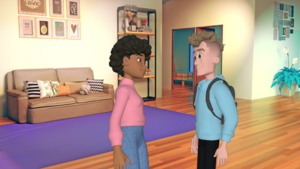
Don't forget to like the video and subscribe to the channel.
Watch the video again while reading the text. Check whether you understand more and pay attention to how the words are pronounced.
A: Waar woon jij?
B: Ik woon in een appartement in Rotterdam.
A: Mooi! Is het groot?
B: Niet heel groot. Ik heb een woonkamer, een keuken, een badkamer en één slaapkamer.
A: Woon je alleen?
B: Nee, ik woon met mijn vriendin. En jij?
A: Ik woon in een studentenhuis met drie andere mensen.
B: Heb je een eigen kamer?
A: Ja, mijn kamer is klein, maar ik heb een bed, een bureau en een kast.
B: En de keuken?
A: Die delen we. Soms is het druk, maar meestal gaat het goed.
B: Kook je vaak?
A: Ja, ik hou van koken. Mijn huisgenoten ook.
B: Dat klinkt gezellig. Misschien kom ik een keer eten!
A: Ja, leuk! Je bent welkom.
Read the English translation. Make sure you understand the Dutch conversation.
A: Where do you live?
B: I live in an apartment in Rotterdam.
A: Nice! Is it big?
B: Not very big. I have a living room, a kitchen, a bathroom, and one bedroom.
A: Do you live alone?
B: No, I live with my girlfriend. And you?
A: I live in a student house with three other people.
B: Do you have your own room?
A: Yes, my room is small, but I have a bed, a desk, and a wardrobe.
B: And the kitchen?
A: We share it. Sometimes it’s busy, but usually it’s fine.
B: Do you cook often?
A: Yes, I like cooking. My housemates do too.
B: That sounds cosy. Maybe I’ll come for dinner sometime!
A: Yes, nice! You’re welcome.
Listen to the conversation and repeat each sentence.
Dutch | English |
het huis (huizen) | house |
Waar woon jij? | Where do you live? |
het appartement (-en) | apartment / flat |
de woonkamer (-s) | living room |
de keuken (-s) | kitchen |
de badkamer (-s) | bathroom |
de slaapkamer (-s) | bedroom |
alleen | alone |
de vriendin (-en) | girlfriend |
het studentenhuis (studentenhuizen) | student house / shared student house |
de kamer (-s) | room |
het bed (-den) | bed |
het bureau (-s) | desk |
de kast (-en) | wardrobe / cupboard |
druk | busy / crowded |
delen | to share |
een keer | once / sometime |
Er is / Er zijn (There is / There are)
Use er is and er zijn to say that something exists or that something is present.
Examples:
er is a “dummy subject” (like English “there”). It doesn’t mean a specific thing.
Write er is or er zijn.
Dutch | English |
het toilet (-en) | toilet |
de gang (-en) | hallway |
de zolder (-s) | attic |
de kelder (-s) | cellar / basement |
het balkon (-en) | balcony |
de tuin (-en) | garden |
Prepositions of place
Dutch | English |
op | on |
onder | under |
naast | next to |
voor | in front of |
achter | behind |
in | in |
tussen | between |
Describing location: special verbs
In Dutch, when you describe where something is, you do not always use zijn (“to be”). Very often Dutch uses special verbs depending on the position of the object:
Verb | Meaning | Use it when… |
staan | to stand | the object is upright (chair, lamp, fridge) |
liggen | to lie | the object is horizontal (book, carpet, bed) |
hangen | to hang | the object is hanging (picture, coat, lamp) |
zitten | to be in / be located | position isn’t clear, or “in” something (key in a bag, person in a car) |
Examples:
The living room (de woonkamer)
Dutch | English |
de bank (-en) | sofa |
de stoel (-en) | chair |
de tafel (-s) | table |
de tv (-s) | TV |
het tapijt (-en) | carpet / rug |
de lamp (-en) | lamp |
Make a few sentences about your living room, like these:
The kitchen (de keuken)
Dutch | English |
de koelkast (-en) | fridge |
de oven (-s) | oven |
het fornuis (fornuizen) | cooker / stove |
de gootsteen (-en) | sink |
het aanrecht (-en) | kitchen counter |
Make a few sentences about your kitchen, like these:
The bedroom (de slaapkamer)
Dutch | English |
het nachtkastje (-s) | bedside table |
de spiegel (-s) | mirror |
het kussen (-s) | pillow |
Make a few sentences about your bedroom, like these:


Walk around your home/apartment and say a few sentences about each room.
Doing exercises is an essential part of the learning process. Don't worry about how many mistakes you make—mistakes are a normal and valuable part of learning.
When checking your answers, focus on understanding why an answer is correct. This will help you learn more effectively and avoid making the same mistakes in the future.