
Watch the video of two students who are talking during the break without reading the text. Try to understand what is happening and what the people are saying.
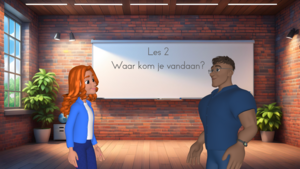
Don't forget to like the video and subscribe to the channel
Watch the video again while reading the text. Check whether you understand more and pay attention to how the words are pronounced.
A: Waar kom jij vandaan?
B: Ik kom uit Spanje. En jij?
A: Ik kom uit Turkije.
B: Woon je in Nederland?
A: Ja, ik woon in Amsterdam. En jij?
B: Ik woon in Rotterdam.
A: Spreek je ook Spaans?
B: Ja, natuurlijk! Spaans is mijn moedertaal.
A: Mijn moedertaal is Turks.
B: En nu leren we Nederlands!
A: Ja, dat is niet makkelijk, maar wel leuk.
Read the English translation. Make sure you understand the Dutch conversation..
A: Where are you from?
B: I’m from Spain. And you?
A: I’m from Turkey.
B: Do you live in the Netherlands?
A: Yes, I live in Amsterdam. And you?
B: I live in Rotterdam.
A: Do you also speak Spanish?
B: Yes, of course! Spanish is my mother tongue.
A: My mother tongue is Turkish.
B: And now we’re learning Dutch!
A: Yes, it’s not easy, but it’s fun.
Listen to the conversation and repeat each sentence.
Holland | English |
Spanje | Spain |
Turkije | Turkey |
Woon je in …? | Do you live in …? |
Ik woon in … | I live in … |
natuurlijk | of course |
de moedertaal (-en) | mother tongue |
nu | now |
niet | not |
makkelijk | easy |
Welke talen spreek jij? | Which languages do you speak? |
Engels | English |
Personal pronouns
ik | I |
jij, je | you (informal) |
u | you (formal) |
hij | he |
zij, ze | she |
wij, we | we |
jullie | you (plural) |
zij | they |
The verb zijn (to be)
Subject | verb | Sample sentence | Translation |
ik | ben | Ik ben Lisa. | I am Lisa. |
jij | bent | Jij bent Tom. | You are Tom. |
u | bent | U bent meneer Jansen. | You are Mr Jansen. |
hij | is | Hij is David. | He is David. |
zij | is | Zij is Ellen. | She is Ellen. |
wij | zijn | Wij zijn vrienden. | We are friends. |
jullie | zijn | Jullie zijn vrienden. | You are friends. |
zij | zijn | Zij zijn vrienden. | They are friends. |
Complete the sentences with the correct form of zijn. The meaning of the sentence is not important.
These lists contain useful expressions that you can use every day. Pay attention to pronunciation and try to learn as many as possible.
Greetings
Dutch | English |
Hoi | Hi |
Goedemorgen | Good morning |
Goedemiddag | Good afternoon |
Goedenavond | Good evening |
Welterusten | Good night |
Tot ziens | Goodbye |
Dag | Bye / Hi |
Doei | Bye (informal) |
Tot morgen | See you tomorrow |
Tot later / Tot straks | See you later |
How are you?
Dutch | English |
Hoe gaat het met je? | How are you? |
Goed, dank je. | Fine, thanks. |
Niet zo goed. | Not so good. |
En met jou? | And you? |
Het gaat wel. | I’m okay. |
Polite words
Dutch | English |
Dank je / Dank u | Thank you |
Bedankt | Thanks |
Alsjeblieft | Please / Here you are |
Alstublieft | Please (formal) |
Geen dank | You’re welcome |
Graag gedaan | You’re welcome |
Sorry | Sorry |
Het spijt me | I’m sorry |
Think about the people you met yesterday and what you could have said to them in Dutch. Try to say it out loud.
Hoe heet jij?
Kom jij uit Nederland?
Waar kom jij vandaan?
Spreek je een beetje Nederlands?
Ik kom uit Nederland, en jij?
Hoe gaat het met jou?
Imagine that you have just arrived at a Dutch language class and someone comes up to you. Act out the first meeting.
Points to include:
2. Dank je b. Goodbye
3. Tot ziens c. Good morning
4. Welterusten d. How are you?
5. Hoe gaat het met je? e. Good night
Doing exercises is an essential part of the learning process. Don't worry about how many mistakes you make—mistakes are a normal and valuable part of learning.
When checking your answers, focus on understanding why an answer is correct. This will help you learn more effectively and avoid making the same mistakes in the future.
1c, 2a, 3b, 4e, 5d