
Watch the video of a student meeting their teacher for the first time without reading the text. Try to understand what is happening and what they are saying.
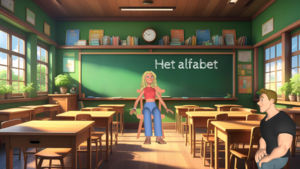
Don't forget to like the video and subscribe to the channel.
Watch the video again while reading the text. Check whether you understand more and pay attention to how the words are pronounced.
A: Hoe heet je?
B: Ik heet Bence.
A: Hoe spel je dat?
B: B - E - N - C - E
A: Oké, Bence. En wat is je achternaam?
B: Mijn achternaam is Farkas.
A: En hoe schrijf je dat? Met een ‘s’ of een ‘z’?
B: Met een ‘s’. F - A - R - K - A - S
A: Bedankt! En waar kom je vandaan, Bence?
B: Ik kom uit Hongarije, uit Boedapest.
A: Mooi! Welkom in de klas.
B: Dank u wel!
Read the English translation. Make sure you understand the Dutch conversation.
A: What’s your name?
B: My name is Bence.
A: How do you spell that?
B: B – E – N – C – E
A: OK, Bence. And what is your surname?
B: My surname is Farkas.
A: And how do you write that? With an “s” or a “z”?
B: With an “s”. F – A – R – K – A – S
A: Thanks! And where are you from, Bence?
B: I’m from Hungary, from Budapest.
A: Nice! Welcome to the class.
B: Thank you!
Listen to the conversation and repeat each sentence.
Dutch | English |
Ik heet … | My name is … |
Hoe spel je dat? | How do you spell that? |
de achternaam (-en) | surname / last name |
de voornaam (-en) | first name |
schrijven | to write |
spellen | to spell |
welkom | welcome |
geen | no / none |
spreken | to speak |
de taal (-en) | language |
Basic word order (Dutch sentence structure)
The basic word order in Dutch is:
Subject (who?) + Verb (what do/does?) + Other information (where? when? with what? etc.)
Examples:
In Dutch, the conjugated verb (for example ben, is, werkt, gaat) is in second position in the sentence. This is also true in longer sentences:
If you are not sure about word order, remember this pattern:
Who? + What (verb)? + Where/When/Other
Put the words in the correct order.
You may not need to spell words very often, but it can happen. It is useful to be able to spell your own name. For the rest, don’t spend too much time on this, as it is not the most important aspect of Dutch. Some of the letters are similar to English, though others can be very different. Listen to the audio to see how letters are spelled.
These are useful expressions you can use when you don’t understand something.
Dutch | English |
Ik spreek nog niet goed Nederlands. | I don’t speak Dutch well yet. |
Spreekt u Engels? | Do you speak English? |
Kun je dat herhalen, alsjeblieft? | Can you repeat that, please? |
Kunt u langzamer spreken? | Could you speak more slowly? |
Wat betekent dat? | What does that mean? |
Hoe zeg je dat in het Nederlands? | How do you say that in Dutch? |
Ik begrijp het niet. | I don’t understand. |
Sorry, ik begrijp u niet. | Sorry, I don’t understand you. |
Ik leer Nederlands. | I’m learning Dutch. |
Kunt u het opschrijven? | Could you write it down? |
Wat is dit? | What is this? |
Doing exercises is an essential part of the learning process. Don't worry about how many mistakes you make—mistakes are a normal and valuable part of learning.
When checking your answers, focus on understanding why an answer is correct. This will help you learn more effectively and avoid making the same mistakes in the future.
1c, 2a, 3b, 4e, 5d