
Watch the video of two classmates talking about birthdays during a break without reading the text. Try to understand what is happening and what they are saying.
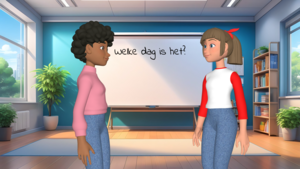
Don't forget to like the video and subscribe to the channel.
Watch the video again while reading the text. Check whether you understand more and pay attention to how the words are pronounced.
A: Wanneer ben jij jarig?
B: Ik ben jarig op 12 oktober.
A: Dat is in de herfst.
B: Ja. En jij? Wanneer is jouw verjaardag?
A: Op 3 april. In de lente.
B: Wat doe je meestal op je verjaardag?
A: Meestal geef ik een klein feestje. Met vrienden en taart.
B: Wat voor taart?
A: Appeltaart natuurlijk! En jij?
B: Ik hou van chocoladetaart. En ik ga meestal uit eten met mijn familie.
A: Leuk! Wat voor dag is het vandaag eigenlijk?
B: Vandaag is het donderdag.
A: En morgen is het al vrijdag.
B: De dagen gaan snel!
A: Ja, en mijn verjaardag is al binnenkort.
Read the English translation. Make sure you understand the Dutch conversation.
A: When is your birthday?
B: My birthday is on 12 October.
A: That’s in autumn.
B: Yes. And you? When is your birthday?
A: On 3 April. In spring.
B: What do you usually do on your birthday?
A: I usually have a small party. With friends and cake.
B: What kind of cake?
A: Apple pie, of course! And you?
B: I like chocolate cake. And I usually go out for dinner with my family.
A: Nice! By the way, what day is it today?
B: Today is Thursday.
A: And tomorrow it’s already Friday.
B: The days go fast!
A: Yes, and my birthday is soon already.
Listen to the conversation and repeat each sentence.
Dutch | English |
Wanneer ben jij jarig? | When is your birthday? |
de herfst (-en) | autumn |
de lente (-s) | spring |
de verjaardag (-en) | birthday |
klein | small |
het feestje (-s) | (small) party |
de taart (-en) | cake |
de appeltaart (-en) | apple pie |
meestal | usually |
morgen | tomorrow |
binnenkort | soon |
het seizoen (-en) | season |
vieren | to celebrate |
de dag (dagen) | day |
de week (-en) | week |
Plural 2: nouns with -s
Dutch has different plural patterns. The most common plural ending is -en (Lesson 5). The second most common is -s.
Simple rule: add -s
Singular | Plural |
tafel | tafels |
kamer | kamers |
telefoon | telefoons |
Apostrophe + s: ’s
If a word ends in a vowel (a, i, o, u, y), Dutch often uses an apostrophe for spelling and readability:
Singular | Plural |
auto | auto’s |
foto | foto’s |
baby | baby’s |
Choose the correct plural form.
How do you say the date?
Vandaag is het 5 juni. (Today is 5 June.)
In Dutch, dates are simple:
Examples:
More examples:
Days of the week
Dutch | English |
maandag | Monday |
dinsdag | Tuesday |
woensdag | Wednesday |
donderdag | Thursday |
vrijdag | Friday |
zaterdag | Saturday |
zondag | Sunday |
Months
Dutch | English |
januari | January |
februari | February |
maart | March |
april | April |
mei | May |
juni | June |
juli | July |
augustus | August |
september | September |
oktober | October |
november | November |
december | December |
lievelingsmaand = favourite month
Look up important dates (birthdays, holidays, etc.). Ask questions and answer them.
Example:
Wanneer is je verjaardag? – Het is op 4 juni.
d
w
d
v
z
z
Doing exercises is an essential part of the learning process. Don't worry about how many mistakes you make—mistakes are a normal and valuable part of learning.
When checking your answers, focus on understanding why an answer is correct. This will help you learn more effectively and avoid making the same mistakes in the future.
dinsdag
woensdag
donderdag
vrijdag
zaterdag
zondag